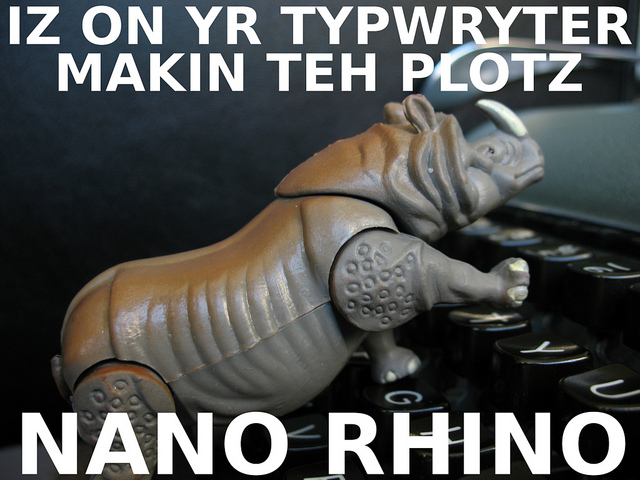
“That thing’s operational.” to quote Lando Calrissian.
Originally written because the Fonzie won’t just hand me the rights to MacGuyver, this book is larger than anything I’ve written. Emotionally Bulletproof – Book 3 was around 50,000 words, including back matter. This thing is over 65,000 words and is designed as two plotlines that steadily converge into a superhero origin story. I plan for subsequent books in the series to focus mainly on one character as he gets into – and out of – dangerous situations in order to help others.
NaNoWriMo was a great success. I wrote 62,000 words, roughly, between November 3 and month’s end. Then it took until Dec. 5 to tickle out the conclusion. 33 days to a novel while working two jobs? It can be done.
Over, under, around, or through – whatever it takes, I’ll do! Except spiders and frontal nudity – at least not at the same time.
So what’s next?
Fresh eyes are good, just ask any book editor or Eskimo. For 2-3 weeks I’ll break from the manuscript to focus on marketing, experimenting with new ideas, plotting the arc for the whole series, and reading research material that should help in that process.
From there, it’s major surgery, plastic surgery, wardrobe, makeup, etc – then off to the beta readers, editors, and proofreaders.
Why do I bring this up? Because I’d love for you to be a beta reader!
If you’d like to get a first look at my novel, in exchange for some notes about what you liked and didn’t, sign up on the right to join my mailing list.
What? You think I’d ignore the people who sign up for that? No, no compadre. They are the honored guests at my house. Bread and water for all of them!
It will be first come first served when I send the invite, so come on over.
I saw that wierd word on a bumper sticker glued to the back of a laptop in a coffee shop a few months back.
It feels embarrassing that as a writer I didn’t know what it was until then.
What is it then?
It’s an acronym that writers added extra letters to, so it became easy to say.
National Novel Writing Month
Apparently lots of authors I have trouble starting a project without a deadline. So worldwide, many authors decide one or two things are going to take place in the month of November:
1. They will complete an entire rough draft of a novel they’ve been thinking about writing but haven’t started. AND/OR…
2. Write 50,000 words towards that project before the month ends.
It’s like No-Shave November, but people have to actually do something.
What’s Been Going on at Author David’s Bulletproof Lab:
This is my first NaNoWriMo, and I’m not doing it because it’s November, I’m doing it to get into the habit of knocking out first drafts in a short time, no matter what.
And the Results?
I have a series idea, and plotted it out so that I could start writing by November. That meant september was a month of research and plot outlining.
With a goal of a finished 60,000 word rough draft by months end I set to work.
Stats:
Week 3 results: 42,639 words written.
Chapters Completed: 23/36
Since one of my weeks was 18,600 words, I am sure I could hit 60,000 if I had to. The truth is, it’s looking like this book might be a bit longer than 60,000 words though. I still have 36% more book to write. Based on an average chapter length of about 1800 words, it looks like I’ll need to write 24,100 words or so to hit my completed rough draft goal. Seeing as I’m developing a habit of working on marketing as well as writing, along with two jobs, it may not be realistic to push for 24,000+ words in a week.
But if I’m anything, it’s unreasonable.
Implications
Since this upcoming book is a series, I may still have to write new characters, plots, and scenes. However, the fact that the character has a history, motivation, and supporting characters, along with a few repeating environments, the pre-book planning process might be a little shorter (4-5 weeks rather than 6-8).
I like to take a break between first draft and revision, so this gives me two weeks to spend a bit more time on marketing and develop some plots for future releases.
The hard part for me is revising. It can be fun when once I start, but I tend to dread it until work really begins. The revising process, and everything leading up to releasing a book, also comes with having to work with other people’s deadlines (editors, beta readers, proofreaders, book cover designers, etc). While I’ve gone through the gauntlet a few times, I’m still looking for an editor that will work within my budget without reducing quality. Someone I can go to over and over. As book sales increase, I’ll probably sink more into having great editors than anything else. To sum up, I can crank out some relatively fast rough drafts in spite of nearly anything, it’s the stuff afterward that needs the most improvement in order to write lots of books and get them out in a decent amount of time. While I still dream of 4 books a year, that dream may not become a reality until the middle or end of next year, with one book – from concept to completion – in a 3 month period being the metric that really shows I’ve got it down.
In this fiction interview, I interview a young journalist who faced career suicide by helping a complete stranger rescue her ex-boyfriend. Her story is covered in my new book, and the rough draft is already done!
For the interview I did on her ex-boyfriend, check out this interview on the victim mentality.
…
Tell me about what happened, but don’t give too much away…
I’d love to. Not long ago, I finished my work day at the television station, and discovered that Jordan Mitchfield had broken up with me.
But why?
He cared about me, but didn’t trust anyone. He couldn’t trust anyone. In a way, he thought breaking up with me would help me move on without him. He was protecting me.
So he was trying to protect someone he cared about, but at the same time he was unsure whether he could trust you?
It’s true. But it didn’t work, because I went to visit him in the mental hospital where he was committed.
How did he react to that?
He had a lot of mixed feelings. It was terrifying because I couldn’t direct those feelings where I wanted them to go – all it would do is make him suspicious of me.
You mentioned at one point that a stranger at the hospital helped you. Who was that, and what did they do?
One of the doctors helped Jordan through some risky and experimental therapy sessions. The results all depended on Jordan’s choices, and the doctor guided him through the sessions enough for him to recover.
There’s more to it than that, right?
There was definitely foul play involved. However, the lawyers warned me not to talk too much about that until after the trial.
You were blacklisted after the events that happened with Jordan? How has your career progressed since then?
I have another job lined up, but it’s the type of job I’m not going to announce until my boss does first. It should start near the end of January.
What did you learn from all this experience?
I learned that you can push to get information out of people. Other times, you have to recognize when your desire to know everything needs to be toned down out of respect for the people you love. If you can do that, they will come to you when they are ready. Things don’t happen according you the timing that would be ‘perfect’ for you.
So, for me, being patient, and respecting the boundaries of those you love – those are the biggest lessons.
There you go, patience is the calm acceptance that things can happen in a different order than the one you have in mind.
…
Authordavid.com News
I plan on moving my blog to a self-hosted site very soon. It will probably happen next weekend, though the change may take a few weeks. During that time, there may be changes to the layout, design, and a few other things. It’s all part of my diabolical scheme to make this blog one of your favorite places on the web.
If your friends don’t have an internet, tell them to get one, so they can read authordavid.com!
If you find yourself visiting the site in the next few weeks, wondering what’s going on – don’t worry! It’s just a growth spurt.
Pictures are for entertainment; messages should be delivered by Western Union – Samuel Goldwyn (of MGM)
If you’re writing a sermon, shame on you if there isn’t some sort of takeaway.
If your ads need to sell product, the theme should communicate that your product solves a deep-rooted need within.
Writing for entertainment is different. Novels, Videogames, and Movies are all escapist mediums. With those, we want to be entertained, to ‘get away’ from our present situations.
When that’s your objective, the idea that we might have to do something lates makes it more difficult to relax.
In this case, theme needs to be almost invisible. But that doesn’t make it less important. If anything, it makes theme more crucial.
Theme Helps Answer Most of Your Pre-First Draft Questions
Without theme, it’s difficult to make the key decisions necessary to shape your story.
Which characters are the best ones to tell the story?
Why would a city be a better setting than an isolated island?
Would a funeral be a better place for a family fight than a graduation party?
What should your conflict be about?
I kind of knew what my theme was about when I started writing my current book: The search for truth is difficult, and takes multiple attempts, but it is worth it in the end.
Theme needs to be communicated by the characters actions. Doing so only with words will turn people off.
In real life, we have enough people telling us one thing, while doing another – that doesn’t resonate with us.
How Theme Guided My Decisions
The search for truth is difficult, and takes multiple attempts, but it is worth it in the end.
With this theme in mind, I knew that one character had to go through this journey. Difficult, disempowering lies needed to grab hold of my main character.
Then, the opposite:
There had to be another character who NEVER did this soul searching, but seemed to have control of everything and everyone. Eventually, the main character needed to surpass this unmoving dinosaur – forever set in their ways.
There also had to be other characters who either weren’t aware or thought the search was a waste of time.
Is my theme the same as what it will be when the whole thing is finished? Mostly.
Over time, I will refine it. That’s a big part of writing and rewriting.
For me, not knowing your theme until your finished is like using a scalpel to turn a kangaroo into Miss Universe – there will be a lot of deep cuts, and there’s a high chance it won’t work.
You can still communicate your message – and Tell A Great Story
If you don’t want people’s lives to be different, you don’t really have anything to say. There’s nothing to talk about.
Even if your story makes no change whatsoever, the thought that it could may give you the juice needed to follow through with your project to the end.
Not every writer does it this way – it’s only how I do it.
A few writers, after many false starts and hundreds of revisions, can make a good story without knowing their theme at the beginning. Even then, they likely refined their craft and subconsciously had an idea of it anyway.
Is it obvious to you when someone is trying to communicate a theme in a story? Has it ever made you love a story more? Less? Let me know in the comments…
“I used to think I was a victim of my story until I realized the truth that I am the creator of my story. I choose what type of person I will be and what type of impact I will leave on others.” – Steve Maraboli, Behavioral Scientist at Michael Thomas Research Center for Social & Behavioral Science, New York.
photo courtesy of yohanl on sxc.hu
Do a lot of bad things happen to you? Have you ever thought about searching for a solution to something that has kept you trapped for years, and thought, why bother?
Everyone has moments like this.
Some of us are in in debt, with little hope of recovery.
More still have lost their faith that they can find a job that meets the needs of themselves and their families.
Worse still, there are those who can identify people by how this mentality rules their lives – who take advantage of it to control people. By making people more dependent, it is possible to make them slaves.
In this post, I am going to interview someone who got out of that mentality. He is the main character of an upcoming book, and is a great case study of how the victim mentality can sneak up on anyone.
He doesn’t want anyone to be a slave of the victim mentality, and neither do I. So I dragged him up out of my head for an interview, and because this happened after the book is over, he doesn’t feel too bad about it.
Enter Jordan.
_____
David: What is the victim mentality?
Jordan: Doctors say it’s where people learn to think of themselves as victims of the actions of others. Eventually, it becomes a personality trait. In my case, I would think, speak, and act as if I were the victim. Sometimes I may have a logical reason, and other times I may have simply said something is wrong with my fate, or that God just doesn’t like me –
David: Just a minute, friend. My itunes keeps opening on me when I’m trying to write this post. No, for the fifth time, I don’t want to listen to Bon Jovi’s You Give Love a Bad Name. Stop playing it!
Jordan: Don’t worry, I’ll take over for you. Basically, you learn it as a child. If you don’t recognize it and take steps to reframe how you see your life, you will always be reacting. Every thing that people do around you will bother you. It’s like your whole body is covered in bruises, and anything another person does feels like a bad masseuse forcing themselves on you.
David: That’s an oddly specific metaphor. Does that come from personal exp– No, iTunes, why must you do this to me?!
Jordan: I had help from close friends who put up with my instability long enough to help me reframe moments of my childhood. When I learned that many of my bad times either weren’t my fault, or that I could reframe those memories so I didn’t see myself as a victim, I became healthier.
<Shot to the heart, and you’re to blame…>
David: Stop ignoring me, Jordan! Give an example or something. Most of our audience aren’t heirs to a billion dollar fortune. Why would a victim mentality stop someone like you?
Jordan: In my case, I was once fired from my own father’s company. It wasn’t even my brother, or dad who did it. An HR manager called me into an office, closed the door, and said I wasn’t a good fit. It reminded me of my mom, who seemed to view me as a nuisance, or when my friends betrayed me in high school. You see how a victim mentality is built over how you see a whole number of experiences?
Then, there’s society at large contributing to the victim mentality – teaching whole generations to be dependent on those who don’t have their best interests in mind. Most love songs that are popular these days, especially breakup songs, reinforce the victim mentality. Most TV shows and Films have characters in extreme conflict. Sometimes this conflict has to be created by manufacturing a victim mentality in the characters. This isn’t going to change, but it would be great if the media that’s put our there can better show the negative consequences of acting out of that mentality.
David: Let’s stay on topic. Have you forgotten that I created you?
David: You’ll need to do better than that…just a moment. iTunes again.
Jordan: And David’s right about the victim mentality. One of the best ways to monitor where you are on the victim mentality is to ask yourself if you are taking responsibility for every aspect of your life. If you find you aren’t, you aren’t alone. Consider these quotes:
If you are taught bitterness and anger, then you will believe you are a victim. You will feel aggrieved and the twin brother of aggrievement is entitlement. So now you think you are owed something and you don’t have to work for it and now you’re on a really bad road to nowhere because there are people who will play to that sense of victimhood, aggrievement and entitlement, and you still won’t have a job.” – Condoleeza Rice, Former U.S. Secretary of State.
David: Now you’re imposing your political views on us, stop it!
Jordan: Is it possible you still have some work to do on the victim mentality? Anyway, the victim mentality is a very politically charged arena. Search for the victim mentality, and you’ll see Democrats, Republicans, Tea Partiers, Race Politics, and many other issues mixed in. It’s good that this debate is happening, because we now know what the victim mentality can do if used or abused by different groups of people. Consider this quote:
And all the congregation lifted up their voice, and cried; and the people wept that night. And all the children of Israel murmured against Moses and against Aaron: and the whole congregation said unto them, Would God that we had died in the land of Egypt! or would God we had died in this wilderness! And wherefore hath the LORD brought us unto this land, to fall by the sword, that our wives and our children should be a prey? were it not better for us to return into Egypt? And they said one to another, Let us make a captain, and let us return into Egypt. – Numbers 14: 1-4 KJV
In this example. We see what it looks like when a group of people have been conditioned to be dependent for four hundred years. Now the deliverer they’ve been promised is leading them to freedom, but the road is difficult. What do they do? Let’s get a leader [to take responsibility for us] and go back to Egypt [where they were slaves].
You see, the victim mentality is a fight for your own freedom. Since I’m in a sci-fi book, the plot will eventually come down to freedom or slavery, as most sci-fi plots do. So, to will your own journey.
David: …Thanks for coming in. I also saw some more interesting writing on the victim mentality over at write change grow. I urge anyone interested in this subject to dig deeper.
Jordan: Just let me know in advance before you bring me in next time, okay?
 Great news!